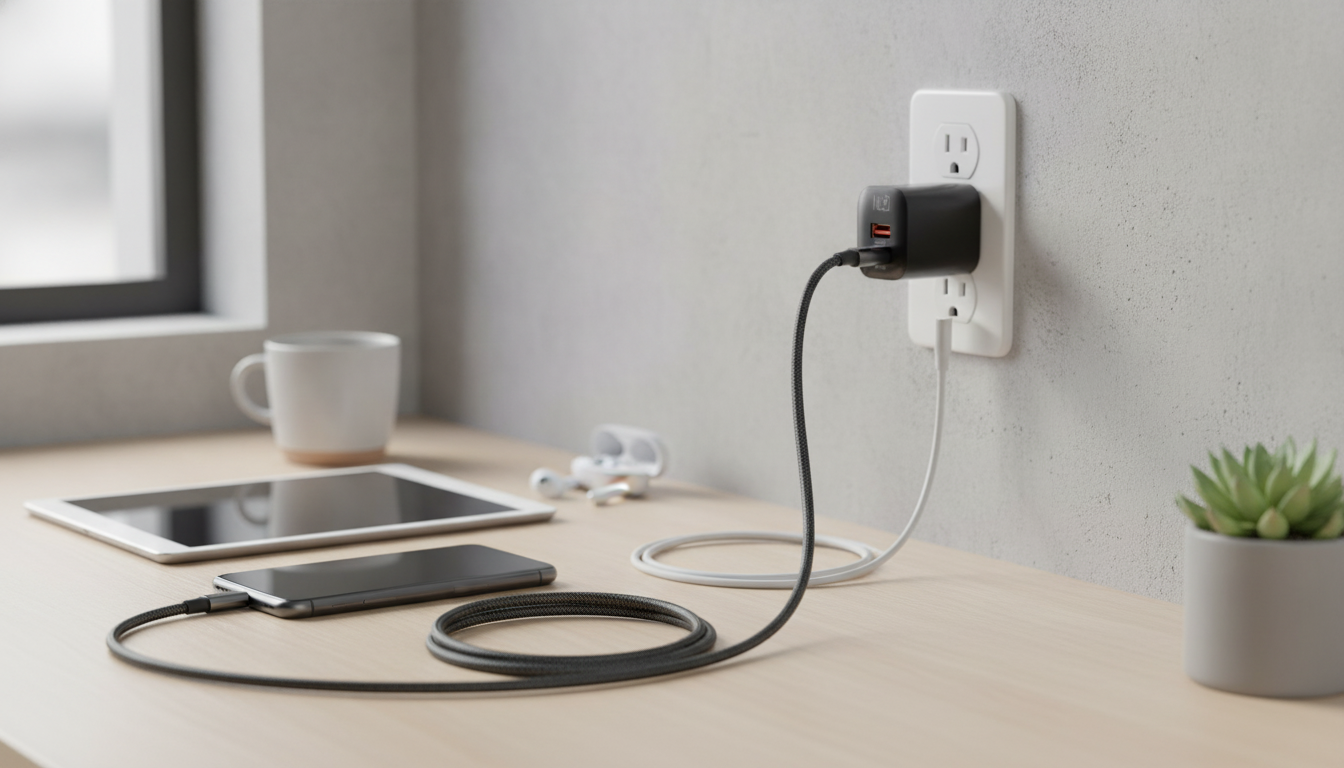
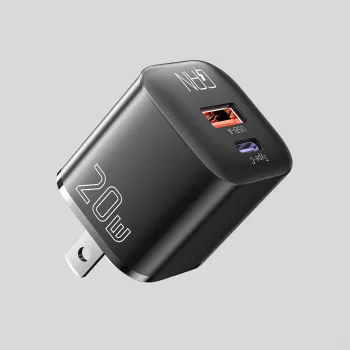
A compact 20W GaN wall charger can replace bulkier adapters while still delivering fast, safe charging for phones, tablets, earbuds, and power banks. The key is understanding what “20W” looks like in everyday use, how USB Power Delivery (PD) and Quick Charge (QC) 3.0 affect compatibility, and why the right cable matters just as much as the brick in the wall.
If the goal is one dependable charger that’s easy to pack and works across a mix of devices, a single‑port 20W GaN USB‑C model is often the sweet spot: fast enough for modern phones, steady for accessories, and simple to use—one port, one device, full attention.
GaN (gallium nitride) charging technology is popular because it can deliver similar power in a smaller footprint than many older silicon-based designs. Less wasted energy as heat can also help the charger stay more comfortable during daily use (real-world results vary by brand and build quality).
In a 20W class charger, that power level is well-suited for:
A single-port design keeps things predictable: your connected device negotiates what it can take, and the charger focuses on that one connection. Most reputable chargers also include safety protections such as over-current, over-voltage, short-circuit, and temperature control—though the exact implementation depends on the manufacturer.
Fast charging isn’t just “more watts.” It’s a conversation between the charger and the device. USB Power Delivery (PD) is the most common fast-charging standard over USB‑C, allowing the charger and device to negotiate voltage and current before increasing power. QC 3.0 (Quick Charge) is widely used across many Android phones and accessories; when both sides support it, charging can be more efficient and faster than basic USB charging.
For Apple devices, PD is the main standard that enables fast charging behavior. Pairing a PD-capable USB‑C charger with the right cable is what unlocks the faster charging mode on supported iPhones.
| Device type | Recommended cable | Likely charging mode | Notes |
|---|---|---|---|
| iPhone (Lightning port) | USB‑C to Lightning (certified) | USB‑C PD fast charging | Charging speed depends on iPhone model and battery level/temperature. |
| iPad with USB‑C | USB‑C to USB‑C | USB‑C PD | Some iPads may draw more than 20W; they will typically cap at what the charger can provide. |
| Android phone (USB‑C) | USB‑C to USB‑C | QC 3.0 or USB‑C PD | Actual speed depends on the phone’s supported standard(s). |
| Earbuds, smartwatch puck, small accessories | USB‑C to USB‑C or USB‑C to USB‑A adapter (if needed) | Standard USB charging | Most small accessories draw low power; fast charge may not apply. |
A charger rated “up to 20W” doesn’t push 20W nonstop. Many phones charge fastest at lower battery percentages and then slow down as they approach full capacity to protect long-term battery health. It’s normal to see a quick jump early on and a more gradual climb near the end.
Heat is the other major limiter. If the phone is warm from gaming, navigation, a thick case, or a hot room, charging speed can drop noticeably. In those moments, the charger may be capable, but the device deliberately throttles to stay within safe temperature limits.
For most everyday phone use, 20W is a strong all-around choice. Larger tablets and many laptops can benefit from higher wattage adapters, especially when charging while in use. With a 20W charger, those bigger devices often still charge safely—just more slowly or only when idle.
A fast charger can only perform as well as the cable connecting it to your device. If charging feels inconsistent, the cable is a common culprit.
| Item | Details |
|---|---|
| Name | 20W GaN USB-C Fast Charger – PD & QC 3.0 for iPhone, iPad & More |
| Output class | Up to 20W (device-negotiated) |
| Port type | USB‑C |
| Standards | USB Power Delivery (PD), Quick Charge (QC) 3.0 |
| Availability | In stock |
Yes. For iPhone models that support fast charging, a 20W-class USB‑C PD charger can enable faster charging when used with a USB‑C to Lightning cable. Actual speed varies by model, battery level, and temperature.
QC 3.0 can benefit compatible Android phones and accessories that negotiate Quick Charge. Devices that prefer PD typically use PD instead, and unsupported devices fall back to standard charging.
Typically no. USB‑C PD devices negotiate power and only draw what they need; the charger doesn’t “force” extra watts into the phone. Use a reputable charger and a safe, undamaged cable for best results.








Leave a comment