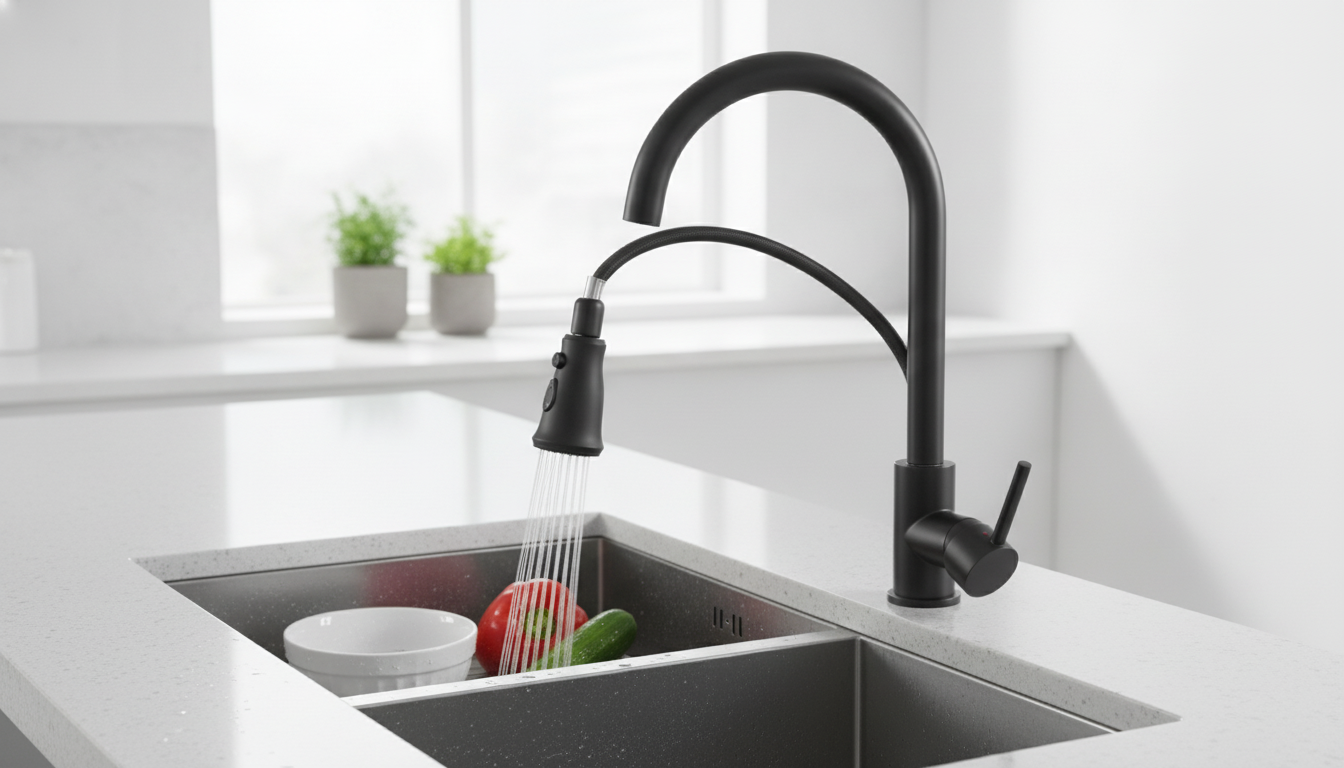
A pull-out kitchen faucet can make everyday tasks—rinsing produce, filling tall pots, and cleaning the sink—feel faster and more controlled. This model pairs a black finish with silver nickel accents, a single-handle control, and a swivel sprayer head to help direct water exactly where it’s needed. The result is a practical, modern look with the flexibility many kitchens rely on day to day.
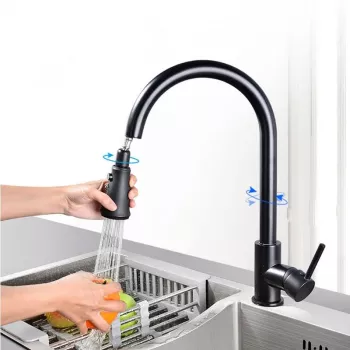
The core advantage of a pull-out kitchen faucet is how it adapts to real sink work instead of forcing you to adapt your workflow to a fixed spout. With a pull-out head and swivel capability, you can reach awkward angles and larger cookware without lifting and repositioning items as often.
This faucet’s design focuses on straightforward control and flexible reach—two features that matter most when the sink is busy.
| Feature | Why it matters | Practical tip |
|---|---|---|
| Pull-out sprayer | Helps rinse dishes and clean the sink without repositioning items | Extend the hose smoothly; avoid sharp bends under the sink |
| Swivel sprayer head | Lets the spray angle follow the task (corners, pots, drain area) | Use small angle changes instead of twisting the hose |
| Single handle | Simplifies switching between hot/cold and adjusting flow | Move gradually to avoid temperature swings |
| Black + silver nickel look | Adds contrast that can match many cabinet hardware finishes | Pair with either black pulls or brushed/nickel accessories for a cohesive set |
Small conveniences add up quickly at the sink. A pull-out head and easy one-hand control can make prep and cleanup feel less like a series of workarounds.
If reducing water waste is part of the goal, it also helps to choose efficient fixtures and build good habits. The EPA’s WaterSense program is a useful reference point for understanding water-saving options and why they matter.
Before picking a faucet based on looks alone, it helps to think through how the finish and functionality will interact with your kitchen’s layout.
For a pulled-together look, choose one “dominant” finish (black or nickel) and let the other show up as accents—cabinet pulls, lighting details, or a soap dispenser—rather than mixing too many metals evenly.
Most kitchen faucet installs follow a familiar pattern: shut off water, remove the old unit, seat the new faucet, then connect and test. A quick checklist can prevent the most common frustrations.
When troubleshooting splatter or inconsistent flow, the simplest fix is often a gentle clean of the spray face or aerator. For general household cleaning guidance—especially if you’re cleaning surfaces around the sink and prep areas—the CDC’s overview on cleaning and disinfecting your home is a reliable reference.
A pull-out sprayer extends your reach, making it easier to rinse corners, wash oversized cookware, and fill tall containers without repositioning everything in the sink. It also offers better control for targeted rinsing during prep and cleanup.
Single-handle control is typically faster because one hand adjusts both flow and temperature. For more precise temperature, move the handle gradually and give the water a moment to stabilize before making another adjustment.
It often pairs naturally with stainless appliances and mixed-metal kitchens. Keep either black or nickel as the dominant finish, then repeat the secondary finish in smaller accents like cabinet hardware or lighting details for a cohesive look.








Leave a comment